
Does My Loved One Need a Guardian?
A Practical Guide for Families in Montgomery and Harris County, Texas
When a loved one begins to struggle with memory, judgment, or the ability to manage daily affairs, families face difficult decisions. One of the most significant options is guardianship.
What Is Guardianship in Texas?
Guardianship is a court-supervised legal relationship in which one person, called the guardian, is appointed to make decisions for another person, called the ward or incapacitated person, who cannot manage their personal or financial affairs.
In Texas, guardianships generally fall into two categories:
Guardian of the Person: Responsible for healthcare, living arrangements, and daily needs
Guardian of the Estate: Responsible for finances, bill payment, and asset protection
In some cases, one individual serves in both roles. In others, responsibilities are divided between different people or entities. Guardianship affects important rights, including the ability to contract, manage money, and decide where to live. Courts require clear evidence before appointing a guardian.
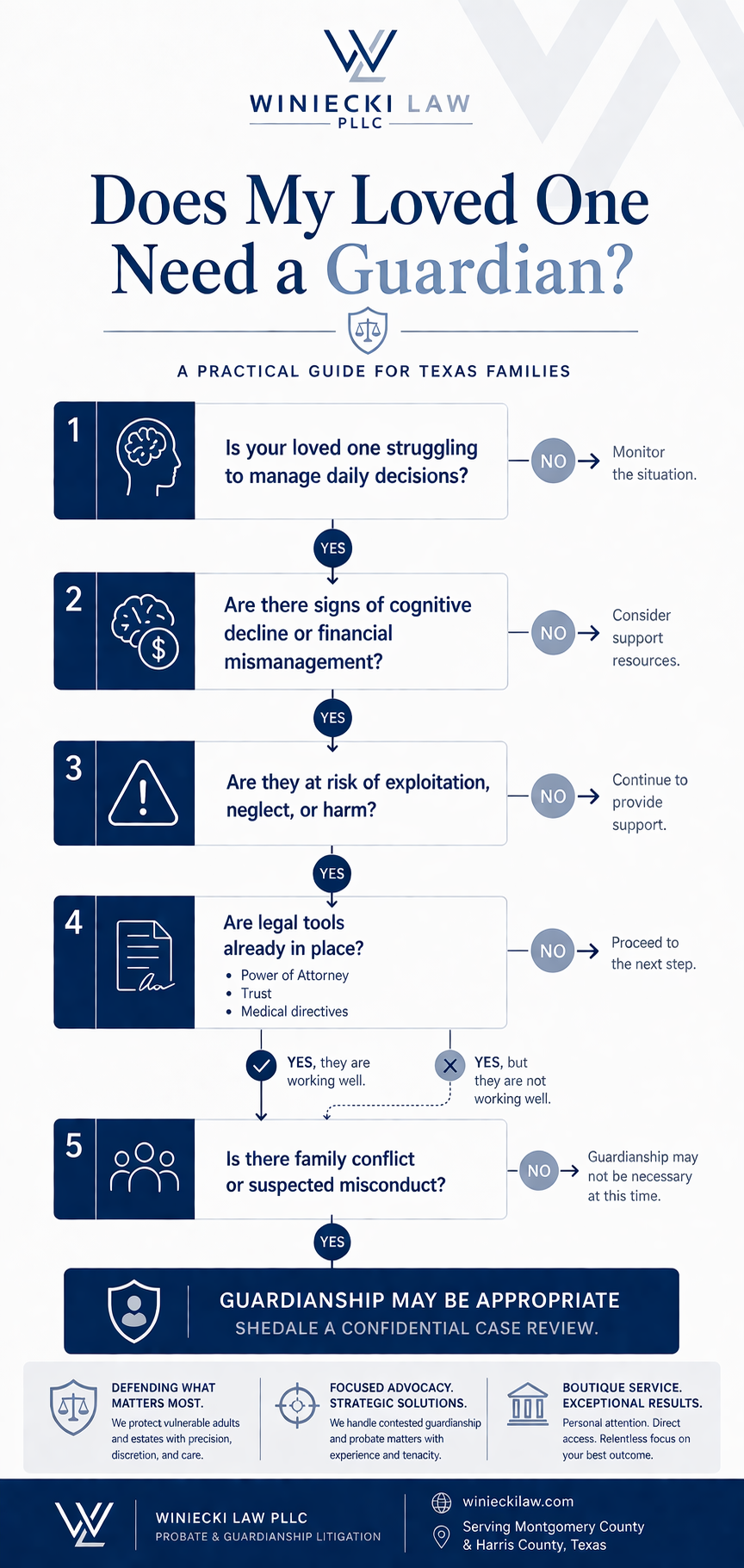
When Should You Consider Guardianship?
Guardianship is one option among several tools available to protect a vulnerable adult. Texas law requires courts to consider less restrictive alternatives before granting a guardianship.
Guardianship may be appropriate when your loved one:
Cannot manage basic financial responsibilities such as paying bills or avoiding scams
Cannot make informed medical decisions
Is at risk of exploitation, neglect, or abuse
Has a condition such as dementia, Alzheimer’s disease, or a serious mental or physical impairment
Is being influenced by someone acting against their best interests
Families often begin exploring guardianship after noticing a consistent pattern of decline that creates risk.
The Legal Standard for Guardianship
To establish a guardianship, the applicant must prove that the proposed ward is incapacitated under Texas law. This usually requires:
Medical Evidence: A physician’s certificate of medical examination that describes the individual’s condition and limitations
Functional Limitations: Evidence that the individual cannot:
Provide food, clothing, or shelter
Care for their physical health
Manage financial affairs
Necessity: Evidence that guardianship is the least restrictive option available
Risks of Waiting Too Long
Delays in addressing these issues can lead to:
Financial loss from exploitation
Declining health and safety conditions
Difficulty recovering assets
Increased family conflict
In some cases, emergency or temporary guardianships become necessary, which can add urgency and complexity.
How to Evaluate Your Situation
If you are considering whether your loved one needs a guardian, ask:
Has decision-making ability declined in a meaningful way?
Are finances or assets at risk?
Is there conflict among family members?
re existing legal documents insufficient or being misused?
These questions help determine whether the situation requires planning or litigation.
How Our Firm Approaches Guardianship Cases
Our firm handles contested probate and guardianship matters in Montgomery and Harris County. We focus on:
Early case assessment to determine whether guardianship is appropriate
Identifying and addressing potential exploitation or misconduct
Managing disputes among family members with a litigation-focused strategy
Coordinating guardianship matters with related probate issues
Each case involves legal and personal considerations. The goal is to protect the individual and bring stability to the situation.
When to Seek Legal Guidance
Guardianship decisions involve complex legal and factual issues. It is worth seeking a case review if:
You suspect someone is taking advantage of your loved one
You are unable to obtain information about finances or care
Family members disagree about decisions
Significant assets or estate issues are involved
Early evaluation can clarify your options and help prevent further complications.
Final Thoughts
Guardianship is a significant legal step that can provide protection for a vulnerable individual. It also carries legal, financial, and personal consequences. Understanding when it is appropriate and what alternatives exist is essential. If this situation sounds familiar, it is worth having your case reviewed as soon as possible.
