
The Application to Appoint Guardian and the Physician’s Certificate of Medical Examination (CME)
The Guardianship Application
A guardianship case starts with a single sworn document, and Texas law is specific about what has to be in it. Leave something out and the omission tends to surface at exactly the wrong moment: at the intake review, or in front of a judge who reads the application more closely than families expect.
Texas Estates Code section 1101.001 requires the application to be sworn to by the applicant, though any person with an interest in the proposed ward's welfare may file it. Beyond the basics, the ward's name, sex, date of birth, and address, and the identity of the proposed guardian, the statute requires the application to state whether guardianship of the person, the estate, or both is being sought, and, since 2015, to address alternatives directly: whether alternatives to guardianship and available supports and services were considered, and whether any of them are actually feasible. The application must also describe the nature and degree of the alleged incapacity and identify which specific rights the order should limit or terminate, such as the right to vote or to hold a driver's license, along with any existing guardianship in another state, background-check information for anyone with care or custody of the ward, and a description of the ward's property.
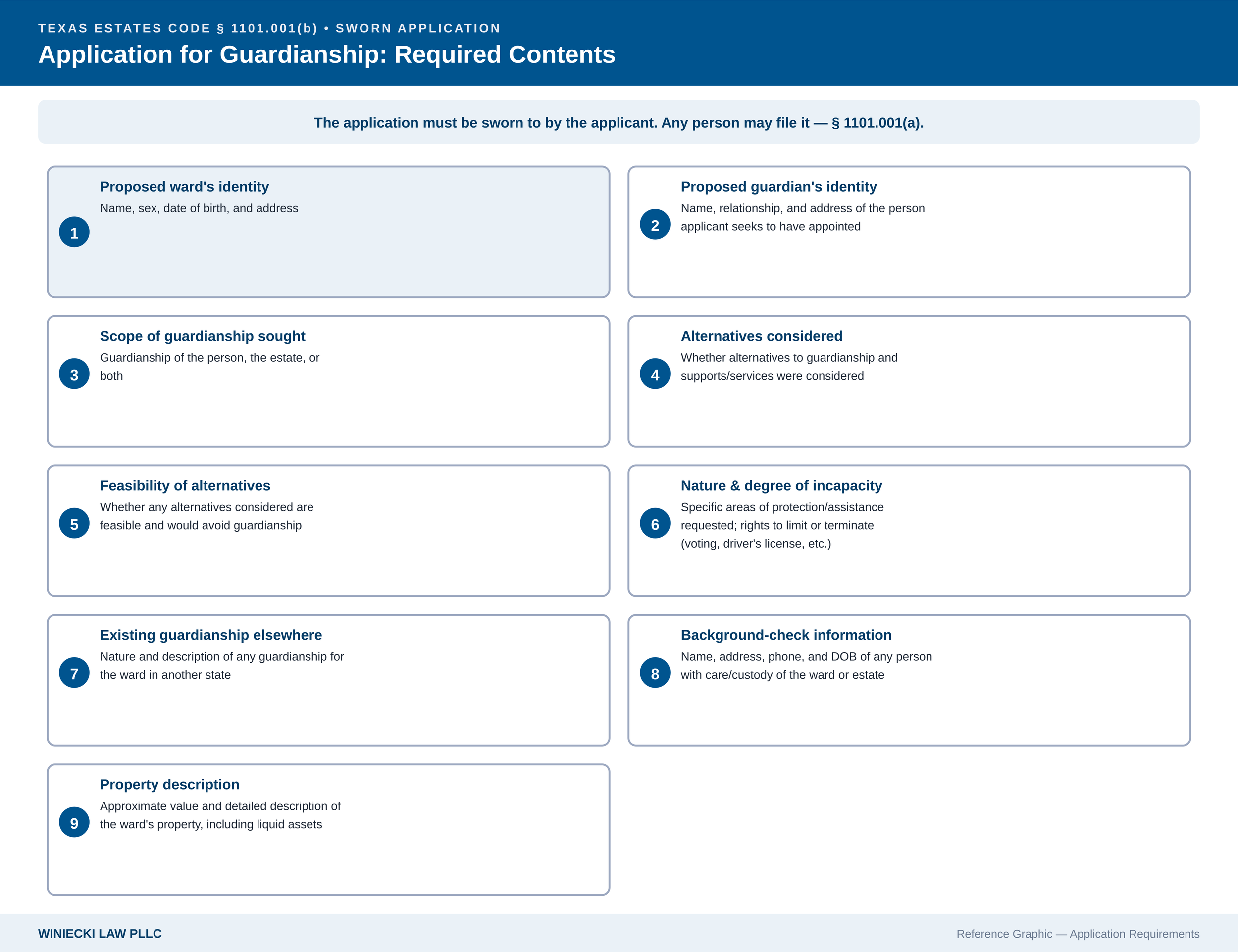
In practice, the alternatives language and the property description are where applications most often fall short. An application that simply asserts incapacity without addressing whether a power of attorney or supported decision-making agreement was considered invites exactly the kind of scrutiny section 1101.101's least-restrictive-alternative policy was designed to prompt.
Practice pointer: treat the application as a checklist, not a narrative. Walk through each statutory element before filing, particularly the alternatives findings, since a complete application at the outset is the fastest way through an uncontested docket.
The Physician's Certificate of Medical Examination
Every guardianship case rises or falls on one piece of paper more than any other: the physician's or psychologist's certificate of medical examination, commonly called the CME. Get the CME wrong and the strongest family narrative in the world will not save the application.
Texas Estates Code section 1101.103 requires that within 120 days before the hearing, a physician or, for certain determinations, a psychologist or advanced practice registered nurse, examine the proposed ward and complete a written certificate addressing specific statutory elements: a diagnosis, an assessment of the proposed ward's mental and physical condition, an evaluation of the proposed ward's capacity to do the tasks necessary to care for themselves or manage property, and a recommendation on the scope of guardianship needed, including whether alternatives to guardianship are feasible. A physician assistant cannot complete the certificate; the statute limits who is qualified to sign it, which trips up more applications than any other single issue.
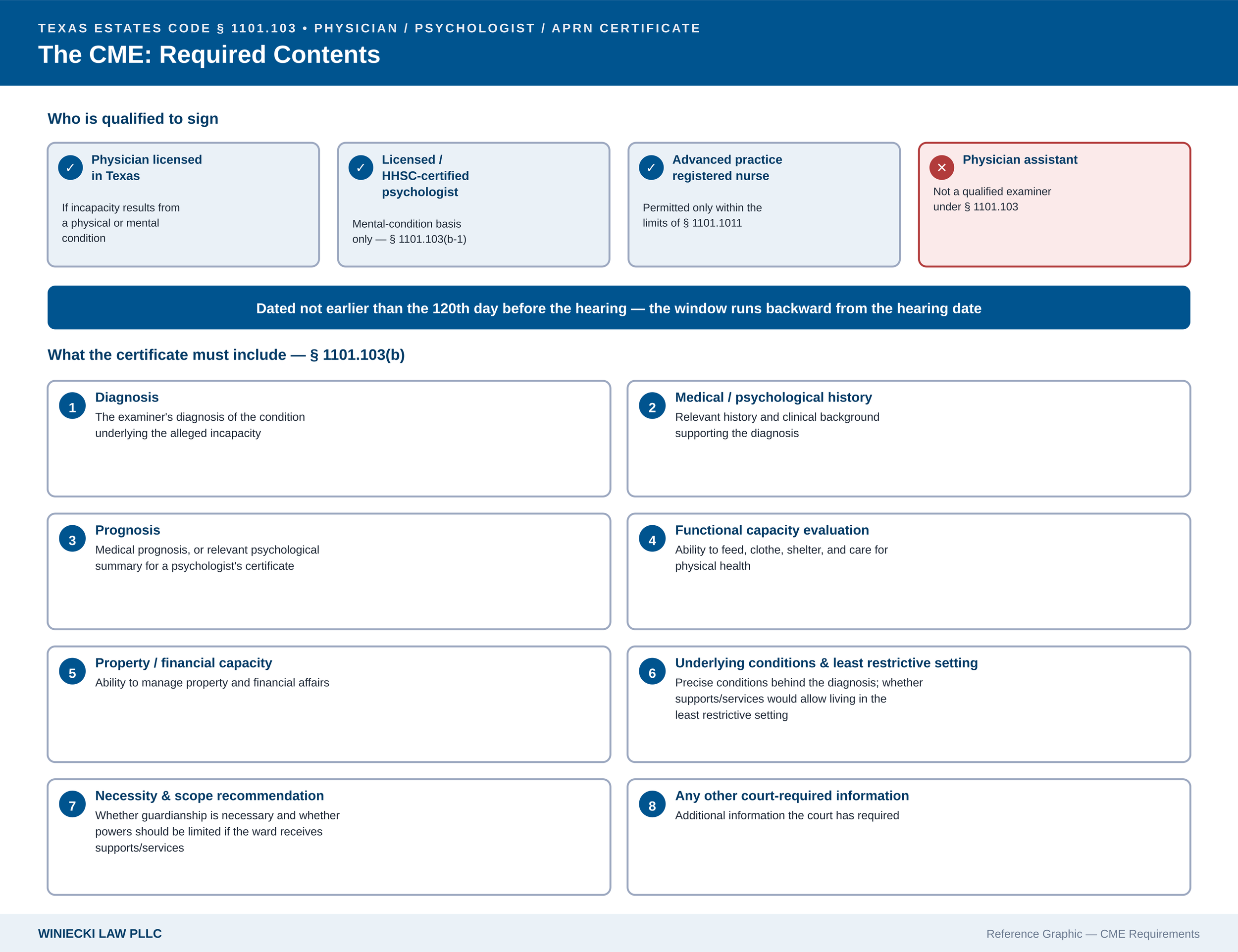
In practice, a family brings in a general practitioner's note that says, in essence, 'patient has dementia and cannot live alone.' That is not a CME. It does not address the statutory elements, it does not speak to specific functional capacity, and it will not survive scrutiny from an attorney ad litem or the court coordinator's intake review. The fix is to get ahead of it: send the treating physician, or a geriatric specialist willing to do a formal capacity evaluation, a form or letter that tracks the statutory language in section 1101.103 point by point, so the physician is not left guessing what the court needs.
A second recurring issue is timing. The 120-day window runs backward from the hearing date, not the filing date. A CME obtained early in a case that then gets continued for several months can go stale, forcing the family to pay for and schedule a second examination right before the hearing. Building in a buffer, or timing the CME closer to the anticipated hearing date once the notice period has run, avoids that expense and delay.
The most common misconception is that the family or the applicant's attorney can simply describe the proposed ward's condition to the court and let the CME serve as a rubber stamp. Judges in these courts read the certificate closely, and a CME that merely recites a diagnosis without connecting it to specific functional limitations, or that fails to address whether a limited guardianship would suffice, invites the court to question the entire application, or to appoint a guardian ad litem to independently investigate capacity.
Practice pointer: do not leave the CME to chance. Provide the examining physician with the statutory checklist from section 1101.103 before the appointment, confirm the exam falls within the 120-day window relative to the actual hearing date, and review the completed certificate before it is filed to make sure it addresses capacity task by task rather than in generalities. A well-built CME often resolves what would otherwise become a contested hearing.
