
Alternatives to Guardianship in Texas: Understanding Less Restrictive Options
When a loved one begins struggling with decision-making, finances, medical care, or daily living activities, families often assume guardianship is the next step. In Texas, however, guardianship is intended to be a last resort. Courts are required to consider whether less restrictive alternatives can adequately protect the individual before appointing a guardian.
For many families, there are legal tools that provide assistance and protection without removing a person’s rights. Understanding these alternatives can help families make informed decisions while preserving dignity, independence, and autonomy whenever possible.
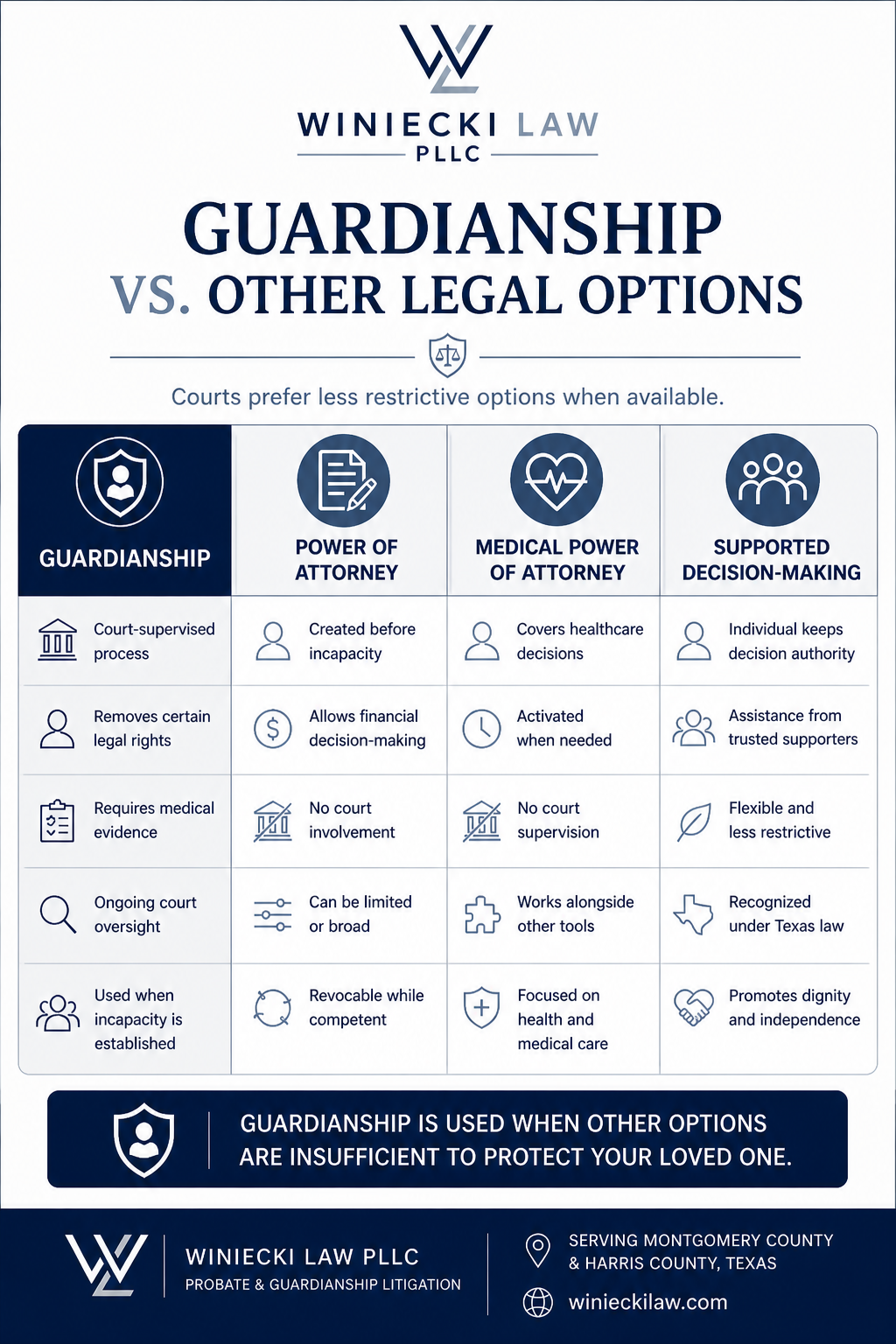
Why Texas Courts Prefer Alternatives to Guardianship
A guardianship proceeding can significantly affect a person’s legal rights. Depending on the circumstances, a guardianship may limit the individual’s ability to manage finances, enter contracts, make healthcare decisions, or determine where they live. Because of the seriousness of those restrictions, Texas law requires courts to evaluate whether a less restrictive option can meet the person’s needs. If a workable alternative exists, the court may deny a guardianship application. The goal is to balance protection with independence. Many individuals need assistance with certain tasks while still maintaining the ability to participate in decisions about their lives.
Common Alternatives to Guardianship in Texas
Several legal and financial tools may help avoid guardianship altogether. The effectiveness of these options depends on the individual’s capacity, support system, and specific needs.
Durable Power of Attorney
A Durable Power of Attorney allows an individual to appoint another person to manage financial and legal matters on their behalf. This document is typically signed before incapacity occurs. The appointed agent may be authorized to:
Pay bills
Manage bank accounts
Handle insurance matters
Conduct real estate transactions
Communicate with financial institutions
Manage investments
A properly drafted Durable Power of Attorney can be broad or limited depending on the person’s wishes. It also avoids ongoing court supervision, which can reduce costs and administrative burdens for families. This option works best when:
The individual still has legal capacity to sign documents
There is a trusted person available to serve as agent
Financial institutions are willing to honor the document
Family members are cooperative
Even with a valid power of attorney, disputes sometimes arise when family members question the agent’s actions or suspect misconduct.
Medical Power of Attorney
A Medical Power of Attorney authorizes another person to make healthcare decisions if the individual becomes unable to communicate informed consent. This document may allow the agent to:
Speak with doctors
Approve medical treatment
Access medical records
Coordinate healthcare decisions
Communicate with hospitals and care facilities
Unlike guardianship, the individual retains rights unless and until the document becomes necessary. For many families, a Medical Power of Attorney is an essential component of incapacity planning. It provides clarity during medical emergencies and helps avoid confusion about who can make decisions.
Supported Decision-Making Agreements
Texas recognizes Supported Decision-Making Agreements as an alternative to guardianship for certain adults with disabilities or cognitive limitations. Under this arrangement, the individual keeps decision-making authority while receiving assistance from trusted supporters. Those supporters may help the person:
Understand options
Review documents
Communicate decisions
Access services and benefits
Supported decision-making promotes independence while still providing meaningful support. It can be especially effective for individuals who are capable of making decisions with guidance and assistance. This option may work well when:
The person understands the consequences of decisions
They can communicate preferences
Trusted support systems exist
Full guardianship would be unnecessarily restrictive
Texas courts increasingly recognize the importance of preserving autonomy whenever possible.
Trust Planning
Trusts can sometimes eliminate the need for a guardianship of the estate by placing assets under the management of a trustee. Depending on the structure of the trust, the trustee may:
Manage investments
Distribute funds for care and support
Pay expenses
Protect assets from misuse
Coordinate long-term financial planning
Trust planning is particularly useful when substantial assets are involved or when a family wants continuity of financial management in the event of incapacity. A trust does not automatically address personal or medical decisions, but it can significantly reduce the need for court involvement over financial matters.
Representative Payee Arrangements
For individuals receiving Social Security or certain government benefits, a Representative Payee may be appointed to manage benefit payments. The Representative Payee is responsible for:
Receiving benefit payments
Paying for the beneficiary’s needs
Maintaining records
Using funds appropriately
This arrangement can help families manage limited financial issues without establishing a full guardianship estate. In some cases, a Representative Payee arrangement combined with powers of attorney and family support may provide enough structure to avoid guardianship entirely.
When Alternatives May Not Be Enough
Although alternatives can be effective, there are situations where they fail or do not provide adequate protection. Guardianship may still become necessary when serious risks exist and no lesser alternative can safeguard the individual.
The Individual Refuses Necessary Help
Some individuals refuse assistance despite severe impairments affecting safety, finances, or medical care. A power of attorney or supported decision-making arrangement may not work if:
The person revokes documents
They refuse cooperation
They deny obvious impairments
They place themselves in dangerous situations
In those circumstances, court intervention may become necessary.
Exploitation or Financial Abuse Is Occurring
Financial exploitation is one of the most common reasons families pursue guardianship. Problems may include:
Unauthorized transfers
Manipulation by caregivers
Online scams
Isolation from family
Misuse of bank accounts
Pressure to sign documents
Even when powers of attorney exist, abusive individuals may misuse those documents for personal gain. Guardianship can provide court oversight and legal authority to stop ongoing abuse.
Cognitive Decline Has Advanced
As dementia, Alzheimer’s disease, or other cognitive conditions progress, alternatives may become ineffective.
The individual may:
Forget prior decisions
Become unable to understand legal documents
Lose the ability to communicate consistently
Require around-the-clock supervision
At some point, the level of incapacity may require a guardian to make decisions and protect the person from harm.
Every Situation Requires Individual Evaluation
No single solution works for every family. Some situations can be managed successfully with advance planning and supportive legal tools. Others require the structure and oversight of a formal guardianship proceeding. The key is evaluating:
The person’s current capacity
Existing legal documents
Family dynamics
Financial risks
Medical needs
Vulnerability to exploitation
Early planning often creates the most options. Waiting until a crisis develops can limit available alternatives and increase the likelihood of court intervention.
Guardianship Should Be a Last Resort
Texas law recognizes that preserving independence matters. Guardianship can be necessary in the right circumstances, but courts generally prefer solutions that protect individuals while allowing them to retain as many rights as possible. If you are concerned about a loved one’s ability to manage finances, healthcare, or personal affairs, it is important to evaluate all available options before pursuing guardianship. At Winiecki Law PLLC, we help families throughout Montgomery County and Harris County assess alternatives to guardianship and determine whether a guardianship proceeding is truly necessary.
Schedule a guardianship consultation to discuss your situation and identify the most appropriate path
