
ATTORNEY AD LITEM AND GUARDIAN AD LITEM; Who Does What?
Two acronyms confuse more clients, and more new practitioners, than almost anything else in guardianship practice: the attorney ad litem (AAL) and the guardian ad litem (GAL). They sound similar, they sometimes get appointed in the same case, and they do fundamentally different jobs.
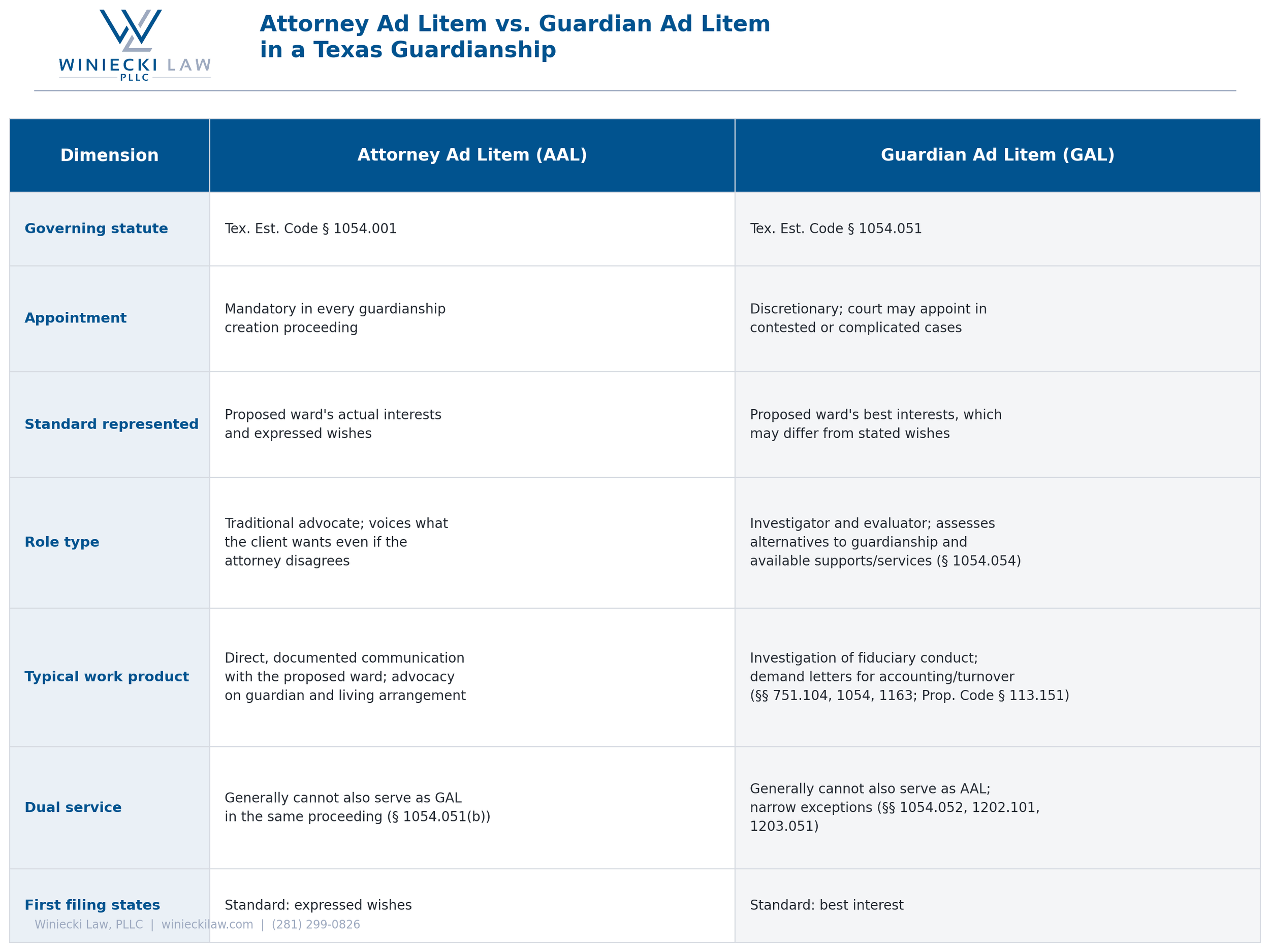
The attorney ad litem is mandatory. Estates Code section 1054.001 requires the court to appoint an attorney ad litem to represent the proposed ward's actual interests and expressed wishes in every guardianship creation proceeding. This is an advocate in the traditional sense, someone whose job is to voice what the proposed ward wants, even if the attorney personally believes guardianship is the wiser outcome. The guardian ad litem is discretionary. Section 1054.051 allows, but does not require, the court to appoint a guardian ad litem to represent the incapacitated person's best interests, which may or may not align with what that person says they want. A GAL can be appointed alongside an AAL in a contested or complicated case, and section 1054.054 spells out the GAL's duty to evaluate alternatives to guardianship and supports and services, not simply to recommend an outcome.
This distinction is not academic. Serving as GAL required drafting demand letters to a power of attorney agent, a trustee, and a prior guardian, seeking a full accounting and turnover of property under Estates Code sections 751.104, 1054, and 1163, along with Property Code section 113.151. That work reflects the GAL's best-interest role: investigating where the proposed ward's assets actually went, independent of what any single fiduciary claims, and reporting findings to the court. An AAL appointed in the same case, by contrast, would be focused on relaying the proposed ward's own wishes about who should serve as guardian and what living arrangement they prefer, even if that position conflicts with the GAL's investigation.
The most common misconception, even among family members who have been through the process before, is that these two roles are interchangeable or that one automatically absorbs the other. They do not. An AAL cannot simply adopt a best-interest position and skip advocating for the ward's stated wishes, and under section 1054.051(b), the same person generally cannot serve as both AAL and GAL in the same proceeding except in narrow circumstances tied to sections 1054.052, 1202.101, or 1203.051. Confusing the two roles in a pleading, or assuming the GAL's recommendation controls the outcome the way an AAL's would not, is a drafting error that gets caught quickly by an attentive judge.
Practice pointer: when you are appointed to either role, state explicitly in your first filing which capacity you are serving in and what standard governs your recommendation, best interest for a GAL, expressed wishes for an AAL. When you are the applicant's attorney, anticipate which role the court is likely to add and tailor your evidence accordingly. A GAL investigating fiduciary conduct needs financial records and demand letters; an AAL representing the ward's wishes needs direct, documented communication with the proposed ward.
