
Is A Guardian Needed?
A family calls after Mom's third fall this year. She is forgetting to take her medication, a contractor she barely knows just redid her roof for twice the going rate, and everyone agrees something has to change. The instinct is to file for guardianship immediately. That instinct is usually wrong, and Texas law says so directly.
Guardianship strips a person of some of the most basic rights an adult holds: the right to decide where to live, how to spend money, and who makes medical decisions. Because the stakes are that high, the Legislature built a threshold requirement into the guardianship statute itself. Before a court can appoint a guardian, Texas Estates Code section 1101.101 requires specific findings that alternatives to guardianship and supports and services available to the proposed ward have been considered and determined not to be feasible. If a less restrictive option would work, the court is not supposed to grant the guardianship.
What counts as an alternative? The Estates Code and related statutes give practitioners several tools to reach for first. A durable power of attorney under Estates Code Chapter 751 lets a person with capacity name an agent to handle financial matters. A medical power of attorney and directive to physicians under Health and Safety Code Chapter 166 covers health care decisions. A supported decision-making agreement under Estates Code Chapter 1357 allows an adult with a disability to keep legal decision-making authority while a trusted supporter helps them understand and communicate decisions. Joint bank accounts, representative payee arrangements for Social Security income, and trusts with a corporate or family trustee can also reduce or eliminate the need for a court-supervised guardianship.
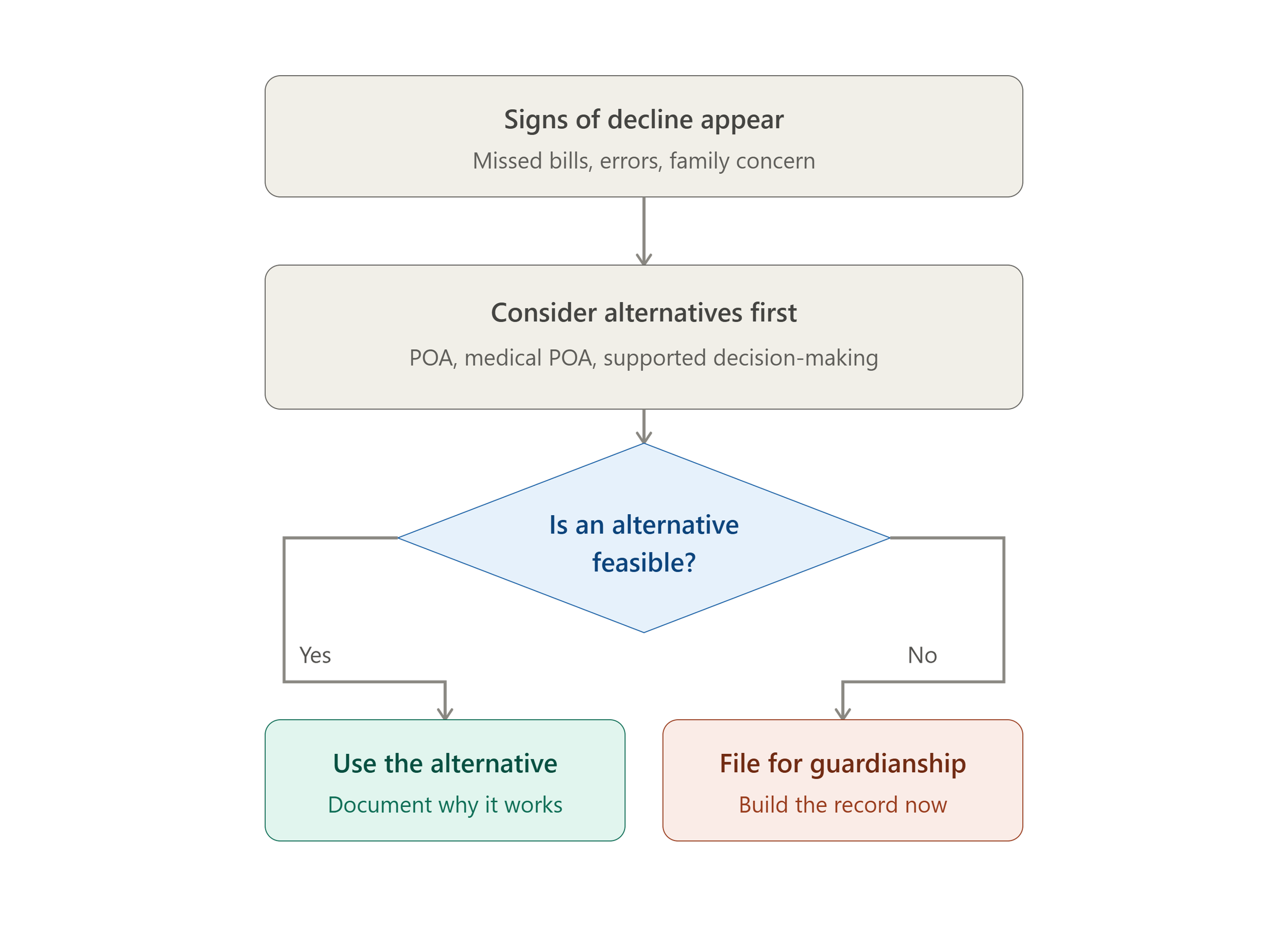
Here is how this plays out in a typical Montgomery or Harris County Texas matters. An adult daughter comes to the firm worried about her father, who lives alone in The Woodlands and has early-stage dementia. He still recognizes family, can hold a conversation, and understands what a power of attorney does when it is explained to him, but he has started missing bill payments and fell for a phone scam. Rather than filing an application for guardianship of the person and estate, the better first move is often to sit down with the father while he still has capacity to execute a durable power of attorney, a medical power of attorney, and a HIPAA authorization naming the daughter as agent. If he lacks capacity to execute those documents, guardianship becomes the only real option, but the file should document why the less restrictive alternatives were considered and ruled out.
The most common mistake attorneys and families make is treating guardianship as the default response to any decline in an aging parent's abilities. Filing without first working through the alternatives analysis creates two problems. First, it invites a contested hearing, because an attorney ad litem or a family member who disagrees with the filing can point to the missing findings under section 1101.101 and argue the case was not ready. Second, and more importantly, it can result in a guardianship that is broader than the person actually needs, since a full guardianship is easier to draft than a properly tailored limited one.
The practice pointer here is simple: before you draft the application, put the alternatives analysis in writing. Document what was considered, who was consulted, and why each alternative was rejected as infeasible. This protects the client, it satisfies the statute, and it gives the court exactly what section 1101.101 asks for instead of making the judge dig for it at the hearing.
