
The Hearing: BURDEN REQUIREMENTS
Filing the application and lining up the CME is only preparation. At the hearing, the applicant has to actually prove incapacity to the court's satisfaction, and Texas sets that bar high on purpose.
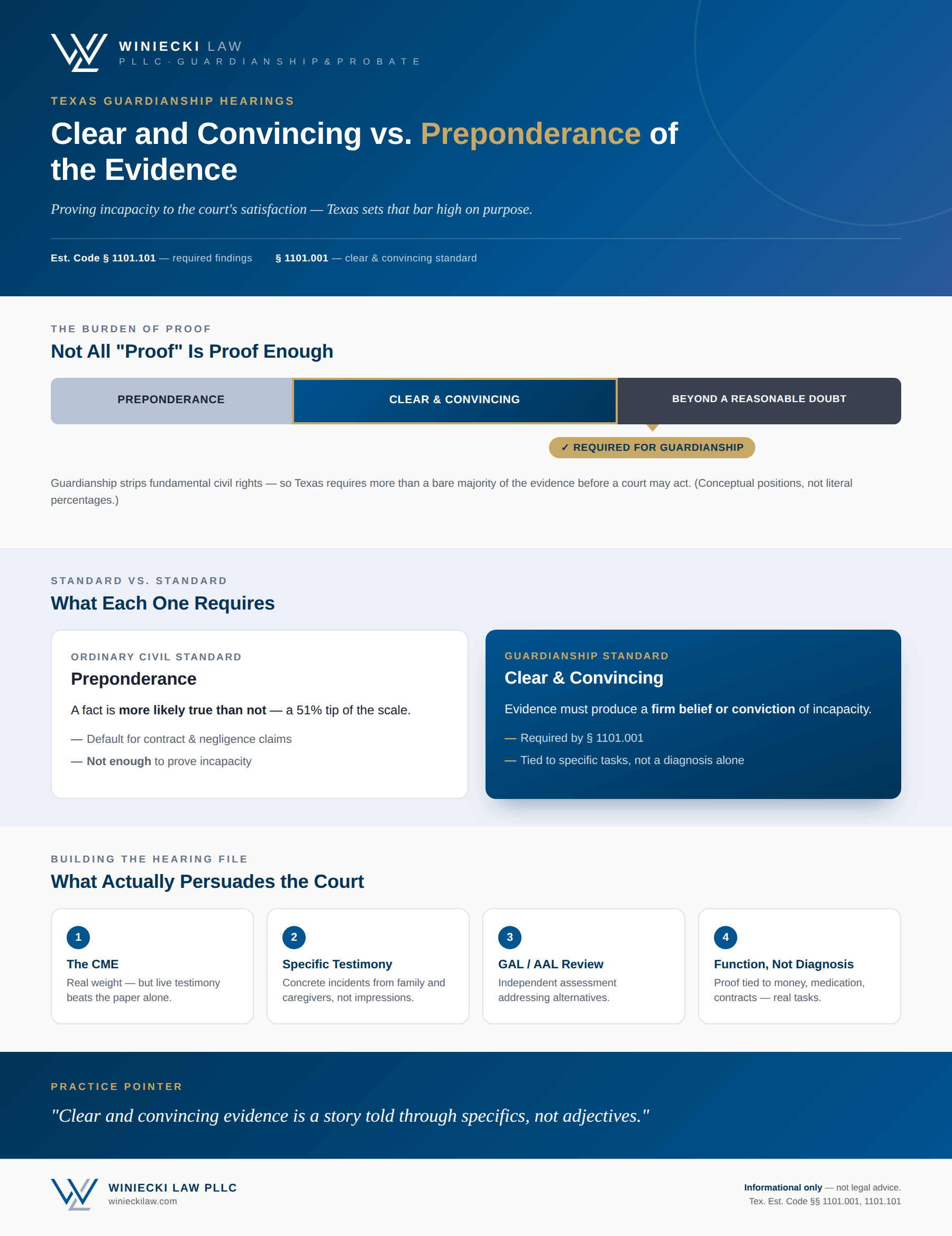
Estates Code section 1101.101 requires the court to find, before appointing a guardian, that the proposed ward is either totally without capacity to care for themselves and manage their property, or lacks the capacity to do some, but not all, of the necessary tasks. Critically, section 1101.001 and related case law establish that this finding must be supported by clear and convincing evidence, not merely a preponderance. That heightened standard exists because guardianship removes fundamental civil rights, and Texas courts, echoing the constitutional concerns raised in cases addressing analogous involuntary commitment standards, have consistently required more than a bare majority of the evidence before stripping someone of legal autonomy.
What actually persuades a probate judge at this heightened standard is rarely a single document. The CME carries real weight, but judges in Montgomery and Harris County statutory probate courts also look for corroborating testimony: a family member describing specific, concrete incidents rather than general impressions, a caregiver or facility staff member describing day-to-day functioning, and, where a GAL or AAL has been appointed, their independent assessment. In one recent Montgomery County matter, testimony from multiple fiduciaries who had handled the proposed ward's affairs, combined with documented gaps in accounting for the ward's property, did more to establish the need for continued protective oversight than the medical certificate alone.
A frequent misstep at hearing is relying too heavily on the proposed ward's diagnosis rather than on functional evidence. A diagnosis of dementia, a traumatic brain injury, or a psychiatric condition is a starting point, not an endpoint. The statute asks whether the person can perform specific tasks, managing money, taking medication correctly, understanding a contract, arranging their own care, and courts want testimony and evidence tied to those tasks. An application that leans entirely on 'the doctor said she has Alzheimer's' without connecting that diagnosis to specific functional deficits risks a continuance or an unfavorable finding, particularly if the AAL is pressing the proposed ward's stated wish to remain independent.
Another common mistake is underestimating how differently a contested hearing runs when the proposed ward, through the AAL, opposes the guardianship. In that posture, the applicant should expect cross-examination on every element, live testimony from the examining physician if possible rather than relying on the paper certificate alone, and a GAL report that squarely addresses alternatives under section 1101.101(a)(2)(D)-(E). Treating a contested hearing like an uncontested one is how otherwise well-supported applications get denied or continued.
Practice pointer: build your hearing file around specific, dated, functional incidents rather than general characterizations, and line up at least one witness beyond the family member filing the application who can speak to day-to-day capacity. Clear and convincing evidence is a story told through specifics, not adjectives.
